
The Turkish insurance market has the capital, distribution infrastructure and growth potential to withstand geopolitical and economic pressures as it targets $50bn of premiums by 2030, speakers told DWIC Connect Istanbul
Türkiye’s insurance sector is targeting further expansion, despite recent years bringing high inflation, currency volatility and the devastating 2023 earthquake.
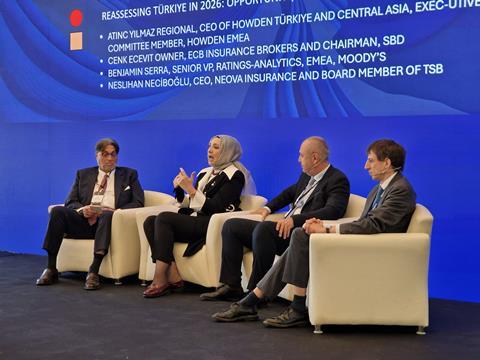
Speaking on the “Reassessing Türkiye in 2026: Opportunity, risk and reality” panel, Neslihan Neciboğlu, CEO of Neova Insurance and board member of the Insurance Association of Türkiye (TSB), highlighted growth across premiums, assets, profitability and equity.
“Total premium production reached $31bn as of the end of 2025. The growth rate is 21% in dollar terms,” Neciboğlu said. “Total assets reached more than $90bn, a growth rate of about 37%. We have approximately $5bn of technical profit in total, increasing 53%, and total equity increased to $11bn, with growth of 35%.”
She suggested Türkiye’s market performance had demonstrated its resilience through a difficult period.
“Because of the economic contraction, inflation, the currency shock and, of course, the earthquake, which all together happened in that period,” she said. “Despite those challenges, the Turkish insurance market is very resilient and very strong.”
TSB is aiming to increase insurance penetration from around 2% today to 5%, while lifting gross written premiums to $50bn by 2030.
“Insurance companies cannot do that by themselves,” Neciboğlu added. “We are together with the authorities, distribution channels and all the stakeholders.”
Distribution key to growth
Cenk Ecevit, owner of ECB Insurance Brokers and chairman of the Türkiye Insurance Brokers Association, said Türkiye remained an agent-dominated market, with agencies responsible for close to 60% of non-life distribution and brokers holding around 17%.
The split differs substantially by business line, however, with brokers playing a much larger role in complex corporate and specialty risks.
“When it comes to corporate lines, especially credit insurance, marine, state-backed credit insurance and property, you can see that the shares of brokers are rising,” Ecevit said.
“Agencies have traditional, trust-based ties and dominate individual non-life lines, most notably motor and third party liability. For broker expertise, brokers command highly technical corporate lines, not only P&I and marine, but specialised credit insurance and other specialised lines as well.”
Benjamin Serra, senior vice president, ratings analytical, EMEA at Moody’s, said Türkiye shared several challenges with the broader global P&C market, although inflation was far less unfamiliar to Turkish insurers than it had been to counterparts in Europe and the US.
“When it comes to the Turkish insurance market, of course inflation is not new, so that’s a difference,” Serra said. “Insurance companies are used to managing inflation,” he added.
Reinsurance opportunity
Catastrophe risk remains a major consideration, particularly following Türkiye’s 2023 earthquake.
Serra said global reinsurers had substantially increased prices and attachment points after several years of elevated catastrophe losses, shifting more losses back towards primary carriers.
However, Türkiye’s earthquake exposure could also make the market attractive to international reinsurers because it provides diversification from weather-driven catastrophe portfolios.
“Earthquake risk is not correlated with weather-related risk,” Serra said. “Normally, for an insurance company, earthquake risk is a relatively good risk because it diversifies well with weather-related risk.
“In theory, you should see a lot of capacity in the market, and you should see appetite. Of course, to get that, you also need to make sure reinsurance companies are comfortable with the risks that they are taking, with the limits, accumulation risk, aggregation and modelling.”
Neciboğlu acknowledged that Türkiye’s position between Europe, Asia and the Middle East meant geopolitical events inevitably has consequences, including through energy prices and inflation.
Nevertheless, she said the insurance market had remained resilient, supported by strong capital adequacy, and expressed confidence ahead of year-end renewals.
“We believe that there will be a good renewal period for the Turkish market again,” she said. “The capital adequacy is very high. If your capital is strong, you can be more resilient across those kinds of challenges.”
Ecevit ended on a similarly confident note: “The capital needs strength, and we’ve got the strength. Türkiye has got the strength. We had lots of troubles in the past, we still have lots of risks existing, but we just had a very major earthquake three years ago, and we continue, and we will continue.”
Regulator speech: Türkiye aims to become regional hub for insurance and takaful
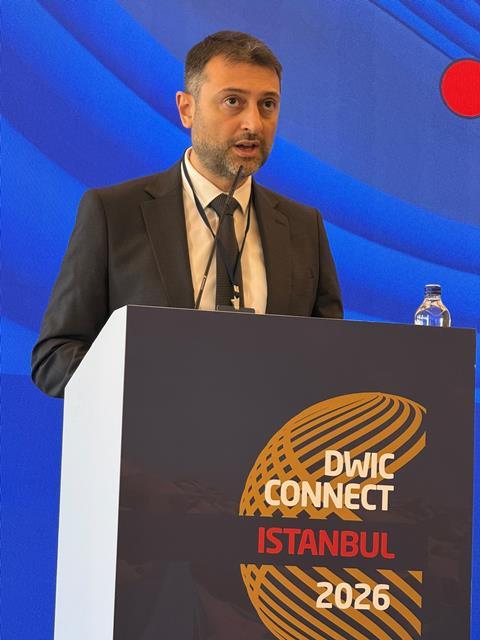
Türkiye is seeking to establish itself as a regional hub for insurance, reinsurance and takaful Islamic insurance products, as regulators push ahead with reforms designed to attract investment and deepen the country’s participation finance sector.
Speaking at the opening of DWIC Connect Istanbul, Insurance and Private Pension Regulation and Supervision Authority (SEDDK) vice president Ali Burak Kurtulan said takaful in particular had gained momentum alongside the development of participation banking.
Citing recent IFSB figures showing global Islamic finance assets at $4.4trn and takaful assets at approximately $70bn, Kurtulan said eight companies currently operate fully in accordance with Turkish participation finance principles, representing around 7% of total premium production.
“As we finalise our regulatory work to align the sector with global standards, we expect to establish a comprehensive infrastructure for the takaful model, sparking new investment interest in our country,” he said.
Draft regulation is intended to broaden participation insurance, strengthen corporate governance, develop specialist talent and provide alternatives for consumers who avoid conventional insurance products because of religious sensitivities.
“With these steps, we aim to transform Türkiye into a regional hub for takaful, creating an ecosystem for international investors and cementing our global position in participation finance,” Kurtulan said.
SEDDK is also working on reforms covering embedded insurance, private health insurance, agricultural insurance, unit-linked life products and emerging financial risks.
“Our ambition is clear: to position Türkiye as a regional hub for insurance, reinsurance and takaful, supported by a strong regulatory framework, a resilient market and a forward-looking vision,” Kurtulan added.







No comments yet