
Nick Line, chief underwriting officer at CFC and chair of Dive In 2026, says the festival has transformed the London market’s culture, but its unspecified successor should sustain momentum on progression, leadership and inclusion in an AI-driven workplace
After 12 editions, 2026 marks the final Dive In Festival. This will inevitably prompt questions about what happens next, what the initiative has achieved, and whether the London insurance market is ready to move on.
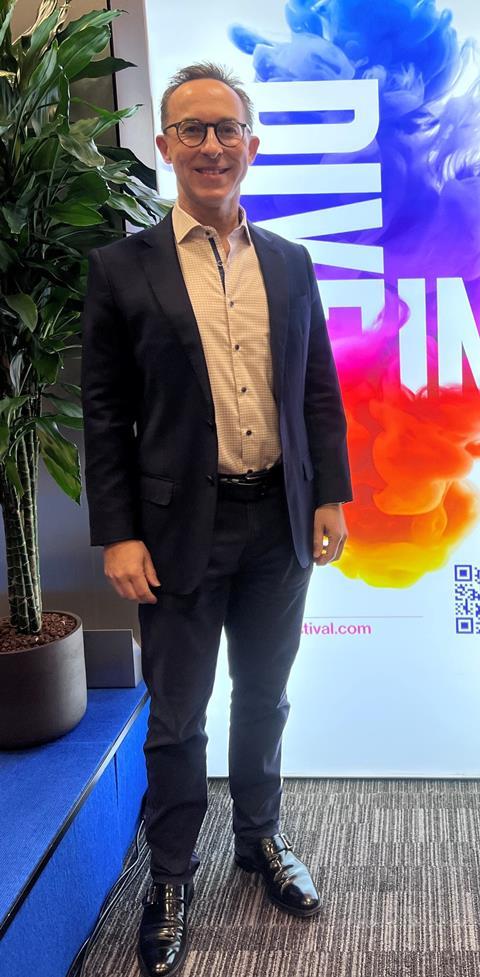
For Nick Line, chief underwriting officer at CFC and chair of Dive In for 2026, the answer lies in understanding the festival’s two distinct purposes.
First, it has provided a place for people from different backgrounds, including communities that traditionally felt excluded from the Lloyd’s market, to share their experiences and support one another.
“As people have come into the market, they can see that they’re welcome and they’re included, and they’re supported,” Line said.
Its second role has been educational, he suggested, encouraging leaders and colleagues to listen to the experiences of others and understand what is required to build genuinely diverse, inclusive and productive teams.
Whether somebody works in a team, manages one or leads an entire organisation, Line argued, they need to understand the value of meaningful diversity and the practical changes that allow individuals to feel welcome.
That can include something as apparently minor as changing the subjects discussed on a Monday morning rather than assuming everybody wants to talk about the previous day’s sports fixtures, he suggested.
“Lloyd’s has made huge progress over 12 or more years in terms of culture, and I feel that Dive In has been a real backbone of that,” he said.
Perhaps the most tangible improvement, according to Line, has been the development of allyship.
When he entered the market, people who witnessed unacceptable behaviour might have felt isolated or unable to intervene. Today, more people understand what is acceptable and are prepared to speak up on somebody else’s behalf, he said.
Inclusion has also become more visible in how firms organise everyday working life.
After-work events are no longer automatically held in pubs. Companies are increasingly considering people who do not drink, have family and caring responsibilities or cannot participate in activities designed around traditional City working patterns.
“The fact that we’re actually being much more considerate of people and kind, which is, to me, what diversity and inclusion is all about, is a huge step forward,” Line said.
A victim of its own success
Dive In is not ending because its underlying objectives have been achieved, he acknowledged.
Rather, Line described the festival as “a victim of its own success”, having expanded across 50 countries and grown to encompass thousands of attendees and hundreds of events.
The environment is also very different from when former Lloyd’s CEO Inga Beale launched the initiative 12 years ago.
“There were almost no HR-run diversity programmes or heads of diversity and inclusion. Recruitment was largely done by taps on the shoulder to your friend from school, family ties to the market, or the nearest broker that you knew,” Line said.
“No proper recruitment at all. No proper promotion. No cultural work at all,” he added.
The scale of subsequent change means the initiative now requires a reset, he argued, potentially involving more focused events spread throughout the year rather than concentrating activity into three days of event.
What follows in a broader sense will matter more than the precise format.
“As long as we have places where people can go to feel included, to share experiences, share challenges and support each other, and also a place where people can go to learn to be in teams, run teams and manage companies that promote a diverse group of people, that’s good with me,” Line said.
Effects of AI
This year’s Dive In theme, “The Human gAIn”, widens the debate far beyond protected characteristics to consider how people will work alongside artificial intelligence.
Line is concerned that discussions about transformation too often focus on systems, straight-through processing or target operating models, without considering the people expected to use them.
“We talk about the human operating model,” he said. “Who are the humans who are going to interact with these tools? What skills do they need? What kind of people do we need to hire? What kind of training do we have to give them? What’s their experience going to be?”
Technology may allow an underwriter to produce 10 times as many quotes, but Line questioned whether businesses have considered the cognitive impact of that workload. Some manual tasks may currently provide opportunities for people to pause and recharge between decisions.
At CFC, he expects agentic processes to remove administrative work and allow underwriters to spend more time meeting brokers, analysing data and developing products.
However, technology does not eliminate the need for human relationships.
When CFC connects its systems to a broker’s technology, the two businesses still meet to discuss the data they will exchange, the insurance questions they will ask and the commercial terms of the relationship.
“That’s a conversation between two groups of people,” Line said. “They have to build trust with each other, build a connection and then have a negotiation.”
Diversity without inclusion is not enough
The same emphasis on human behaviour applies to diverse teams.
Line said his involvement in diversity and inclusion caused him to reassess his experiences of managing actuarial teams and working in a historically male-dominated market.
“I’ve realised over time that diverse teams are better. They’re more powerful. They’re more creative. They challenge each other. They produce better results. They’re more innovative,” he said.
Line recalled attending meetings where participants looked alike, agreed with each other and made decisions he believed were “catastrophically wrong”.
“I’ve seen people suffering from groupthink,” he said. “I know it’s a theoretical concept, but I’ve seen it in practice.”
That lesson is particularly important in a regulated, high-risk industry. If somebody identifies a problem in a policy or spots an external development that could affect the portfolio, they must feel able to raise it.
Progression in focus
While progress is visible in recruitment, Line believes the greater challenge now concerns progression and leadership.
The market has widened its early-careers pipeline through apprenticeships, graduate programmes and more structured hiring. Recruitment based on knowing a “good chap” who can “hit the ground running” has increasingly been replaced by open processes, proper job descriptions and properly governed interviews.
However, the same rigour ought to continue after somebody joins a company.
Parental leave policies have improved significantly, with fathers increasingly taking extended periods away from work. Yet women remain underrepresented in the most senior underwriting and executive positions.
Employees who spend more time in the office tend to be offered additional responsibility and advancement. Over time, this causes careers to diverge, even without an explicitly discriminatory promotion decision.
Almost half the underwriters encountered in the Lloyd’s underwriting room may be women, Line observed, but their underwriting director or active underwriter is still more likely to be a man.
The question is whether this is a generational lag that will correct itself as more women progress through the market, or evidence of a systemic obstacle.
Tempting shortcuts
Discussion turned to the temptation to accelerate change by appointing female non-executive directors. Such appointments can rapidly improve board-level statistics, but they do not necessarily demonstrate that women are progressing through underwriting and executive careers.
Line was strongly opposed to appointments that could cause somebody to question whether they had been selected on merit.
“The last thing I would ever want to do is have any woman sitting on a board wondering whether she got there on merit or not,” he said.
He indicated he would rather see sustainable progress than organisations jump directly to a leadership target without addressing more profound issues of recruitment and progression.
A female non-executive can provide an important role model, he acknowledged, but the market must also ensure women advance through traditional operational roles into the C-suite.
Five years from now, Line hopes the industry can look back and conclude that Lloyd’s created a “worthy successor” to Dive In: one that maintained its communities, continued teaching the value of diverse teams and extended its impact throughout the year.
“We want to look back and not see a slowdown – we’ve got to maintain the momentum,” he said. “It’s not just banking the gains; at all leadership levels, there’s lot more work to do.”









No comments yet