
Javier San Basilio told GR he expects an orderly renewal season as reinsurers increasingly differentiate between individual clients, while the group continues to diversify through ILS, life business and growth markets
The softening reinsurance market will continue towards an orderly renewals season, with pricing increasingly reflecting the individual merits of cedants rather than the broad market movements seen in recent renewals.
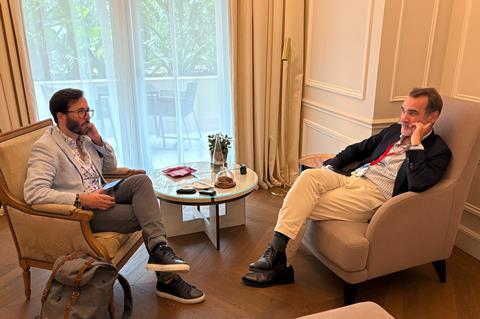
That was the view from MAPFRE Re’s general manager, Javier San Basilio, (pictured speaking speaking with GR editor David Benyon) at RVS 2026 in Monte Carlo, buoyed by a positive performance in the first six months of the year.
San Basilio said MAPFRE Re had enjoyed a strong first half to 2026, helped by relatively low catastrophe activity and several years of portfolio management.
“The first half was a 25% increase from the prior year,” he said, referring to MAPFRE Re’s net profit of €186m in the first half of this year.
“It reflects a combination of very little catastrophe activity and of the portfolio management we’ve done throughout the past five years.
“The portfolio is in much better shape than it was,” he added.
Property cat pricing has softened significantly in the past few renewals, but San Basilio said MAPFRE Re’s broader portfolio makes its performance less sensitive to pricing movements in cat excess of loss (XoL) business.
“Our book is more stable now. We have a strong proportion of book in which the fluctuation of prices is not as steep as it is on the cat XoL book,” he said.
More differentiation
San Basilio described conditions heading towards renewals as “orderly”, despite softening pricing movements.
“There’s going to be some changes, and I think there’s going to be much more client differentiation,” he said.
“In the past few years, there’s been a broad-brush approach and it’s plus 25% for everyone or minus 15% for everyone. Now I think it’s much more focused on each client’s conditions and merits, and that’s something we like. It suits us nicely,” he continued
Latin American property renewals have already shown pricing reductions, although San Basilio cautioned against relying too heavily on regional averages.
On XoL business, he mentioned decreases of between 5% and 15% depending on the market in 2026 renewals, with the upper end an extreme outcome in Latin America.
“Giving broad market averages is tough because you lose the perspective on each individual client,” he said.
The relative absence of major insured cat losses has contributed to the calmer market environment.
While this doesn’t create compelling headlines, San Basilio is content with the situation.
“We like boring! In our industry, we think boring is not such a bad thing,” he said.
“But at the same time, boring doesn’t mean you don’t look for alternatives and for options and what the clients really want from you,” he added.
Diversifying the portfolio
One area of development has been MAPFRE Re’s use of insurance-linked securities (ILS).
MAPFRE added its first indemnity-based catastrophe bond for the group’s US portfolio this year, alongside existing index-based ILS transactions protecting US and European reinsurance exposures.
San Basilio suggested ILS provides additional options alongside traditional retrocession relationships.
“We have been able to build some new relationships and find additional protection, and it has provided greater optionality in our coverage without damaging the strong relationships with the traditional partners, which is important for us,” he said.
MAPFRE Re is looking for further diversification geographically through Asia Pacific, as well as life reinsurance, he explained.
The reinsurer has recently established an Indian branch, gaining approval for its GIFT City operation in February, after around 12 years of trading with the market and longstanding operations across the region.
“We see growth potential, diversification potential. We want to do all lines of business, to be more relevant to the clients,” San Basilio said.
Life reinsurance business has meanwhile grown to nearly 20% of the MAPFRE Re portfolio, following the creation of a structured business unit over the past two years, with San Basilio content to let it grow to around 25% of the portfolio.
“Life provides useful diversification from the volatility of property cat, in terms of our results and the pricing environment,” he said.
MAPFRE Re’s position as a reinsurer and a significant buyer of retrocessional protection continues to provide useful visibility across both sides of the market, coming to the Monte Carlo rendezvous as a buyer and seller.
“We see business from both sides of the transaction, and it helps us get a better perspective,” San Basilio said. “We’re in a stable position, and we also think the retro market is behaving more reasonably.”







No comments yet