
Cathal Carr, founder and CEO of OAK Global, discusses the reinsurer’s rapid expansion at Lloyd’s, its hybrid capital model, move into retro and how a greenfield technology strategy is shaping its approach to emerging risks
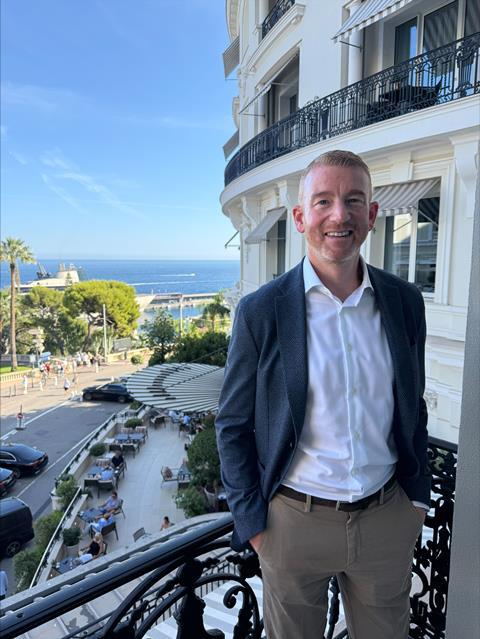
OAK Global’s CEO was at the Monte Carlo rendezvous this year looking to deepen relationships with its growing client base.
Founder and CEO Cathal Carr (pictured) has built a reinsurance business approaching $1bn of premium income in only its second year, when he met GR at RVS 2026.
The reinsurance business spent 2024 raising capital before launching on 25 November that year, ahead of 2025 renewals.
Throughout that time, Carr said the London market has stood out when OAK considered where to establish and grow the business, citing Lloyd’s ambitions to grow reinsurance, as well as advantages for capital structure and access to talent.
“Everything starts with talent,” he told GR. “London is the most talent-dense jurisdiction for insurance and reinsurance, globally. It’s in the lead by far in terms of access to talent within underwriting and all of the broader functions.”
The ability to increase capital for each successive Lloyd’s year of account has also offered advantages for a start-up, he said, particularly at a time when investors had become wary of capital-heavy businesses.
OAK established a hybrid model, with investment firm Bain Capital providing “working capital and cornerstone underwriting capital” alongside several third-party sources.
These include private Lloyd’s Names through members’ agents such as Alpha, Argenta and Hampden Agencies.
He described Names as a “very sticky, resilient form of capital”, with OAK using a modified freehold structure designed to provide greater certainty over their continued participation.
“For the 2026 year of account, we’re just over £500m of capacity across our two syndicates, and the Names capital account for just over 50% of that,” Carr said.
Adding retro
OAK began with Lloyd’s Syndicate 2843, focused on primary reinsurance, which Carr said will underwrite just over $800m of income this year.
It added Syndicate 1440 at Lloyd’s in 2026 to target retrocession business, an area for which Carr is keen to develop specialist underwriting expertise.
“We feel there is a significant opportunity in the market for an underwriting business that has talent and expertise to provide deep knowledge in retro, because it’s a specialty product,” he said.
The move also reflects increasing overlap between buyers of traditional reinsurance and retro, he suggested, as insurers and reinsurers become more integrated and purchasing strategies more centralised.
“We’ve got 600 clients globally now across our business, across both of our syndicates,” Carr said.
He added that OAK’s coordinated approach across the business had been “a key differentiator for us since we launched the business, to write in total just under one billion dollars of income in 2026.”
About half the portfolio is property, with the remainder spread across marine, energy, terrorism, marine specialty, cyber and credit-related classes.
Carr seeks to capture further emerging risk opportunities through OAK Horizon, an initiative focused on climate and technology change over the next five, 10 and 20 years.
New technologies, however, create a different underwriting challenge where insurers cannot rely on their usual source of underwriting confidence: decades of historical loss information.
“If we think about emerging technologies around green hydrogen, or battery storage, as we think about the electrification of the grid and how AI will be utilised to distribute power, those new products don’t have decades of statistical data to build out future-looking pricing models,” he said.
“What that means is there is a need for us to develop dynamic pricing models to acknowledge the uncertainties there – and ultimately try to underwrite that.”
Building without legacy constraints
OAK’s relatively clean technology slate gives it an opportunity, Carr believes, to build better underwriting processes around modern data infrastructure, rather than adapting legacy systems like incumbent rivals in the market.
The startup expects to reach 90 employees globally by the end of 2026 and has deliberately recruited from a broad range of organisations, trying to avoid importing a single ‘way of doing things’ in the development of its own working style and culture.
“We’ve hired no more than two people from any given company,” Carr said. “The key reason behind that is we don’t bring in a ‘well, this is the way we did it’.”
OAK has also established a technology company, ROOT Intelligence, in Dublin and worked with Amazon Web Services on its data infrastructure, Carr explained.
He emphasised the importance of collecting and connecting information from initial submission through pricing, portfolio construction and ultimately claims and cash flows.
Much of that can be done more effectively using newer systems and technologies.
“The ability to create tools and systems today, relative to three years ago, is night and day,” he said.
Technology will increasingly have to help underwriters understand risks that cut across traditional product boundaries, he suggested.
“We are moving into a world where the interconnected nature of risks across a number of these emerging areas are growing,” he said.
The industry still has significant work to do in modelling correlations and potential clash scenarios between emerging exposures, he added.
For OAK, its relatively modest shares on existing programmes leave ample room to expand without needing to chase new areas purely for growth, he stressed.
“We’ve written close to 1,300 individual programmes, so nearly three programmes per client,” Carr said. “Our shares are relatively modest, so we’ve deliberately achieved that breadth of engagement globally.
Continued growth means relevance to those clients, but this is not just about scale or capacity, he hinted.
“We have the ability to continue to engage with our clients to support them in a more meaningful way, but doing that more thoughtfully,” Carr added. “There’s a huge amount of opportunity out there, as we think more and more about innovation, capital, technology, and evolving risk.”









No comments yet