
Competition intensified at the January 2026 renewals, with double-digit price reductions in property and new options opening for insurers to redeploy savings into earnings protection and growth, according to the re/insurance broker’s renewals report.
Record levels of reinsurance capital reshaped the January 1 2026 renewals, creating a buyers’ market across much of property and improving optionality for insurers looking beyond pure price, according to Aon.
Aon estimates global reinsurer capital reached a new high of $760bn at the end of September 2025, up $45bn year on year, driven primarily by retained earnings and sustained inflows of third-party capital.
Despite insured catastrophe losses exceeding $100bn for a sixth consecutive year, reinsurers are set to deliver another year of strong profitability.
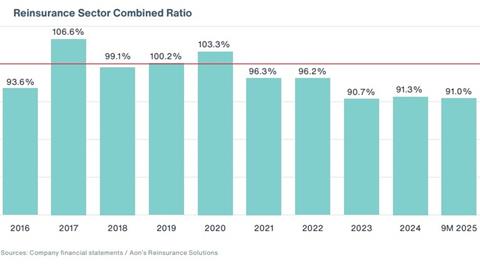
One measure of profitability among reinsurers can be seen in the chart of combined ratios opposite, staying profitably below the 100% line again in 2025, amid the relative lack of cat losses for reinsurers.
Average annualised return on equity for the sector reached around 16% in the first nine months of 2025, well above the estimated long-term cost of equity.
That capital strength translated directly into competitive renewal outcomes.
Property catastrophe pricing softened sharply across major regions, emphasised the re/insurance broker.
In the US, preferred non-loss-impacted risks typically achieved strong double-digit rate reductions.
Europe, Latin America and Asia-Pacific also recorded double-digit discounts in most cases, with non-loss accounts in Asia-Pacific approaching 20% reductions.
While most insurers were broadly comfortable with their core protections at 1 January, Aon expects many to return to the market during 2026.
The report points to growing interest in deploying premium savings to strengthen capital positions, reduce earnings volatility and support profitable growth initiatives.
Capital abundance and the rise of alternatives
Third-party capital continued to play an increasingly central role in renewal dynamics.
Alternative capital reached a new high of $124bn by the end of the third quarter, supported by strong investor returns and appetite for non-correlating risk.
Catastrophe bond issuance hit record levels in 2025, with more than $24bn issued across 74 sponsors and $59bn outstanding.
Sidecars also expanded materially, particularly in property, while casualty sidecars began to gain traction from a lower base.
Aon also noted that investors were attracted by a combination of benign catastrophe outcomes, elevated margins and higher interest rates, which boosted collateral returns.
That influx of capital not only softened pricing but broadened the range of structures available to buyers.
Frequency covers, earnings protection, structured solutions, loss portfolio transfers and hybrid treaty and facultative facilities all featured more prominently at renewal.
Aon said it expects further growth in these areas as insurers look for more flexible ways to manage volatility and deploy capital efficiently.
From pricing relief to growth opportunities
Beyond renewals, the report highlights how excess capital is encouraging insurers and reinsurers to look for new sources of demand.
One of the most significant opportunities identified is the rapid expansion of global data centre infrastructure.
Between 2026 and 2030, cumulative global insurance premiums linked to data centres are estimated at around $134bn, driven by rising values, lender-driven insurance requirements and the scale of new construction.
Evolving regulatory and litigation environments are also expected to support growth in casualty.
Aon estimates emerging risks in the casualty sector could contribute approximately $5bn of reinsurance premium annually.
Conditions for casualty renewals were favourable, according to Aon.
Increased capacity supported competition for international business and stability for US placements, despite ongoing concerns around nuclear verdicts and litigation funding.
Improving underlying results and strong investment income left many casualty insurers in a stronger negotiating position than in recent years.
Aon also points to a more favourable facultative environment, with growing capacity and innovation supporting insurers looking to de-risk portfolios and expand into new lines or geographies.
Hybrid treaty and facultative structures are increasingly being used as strategic tools rather than tactical stop-gaps.
“Buyers returning to the market will find a wide range of complementary reinsurance and capital products,” said Alfonso Valera, international CEO for reinsurance solutions at Aon.
“We are seeing growing interest in bespoke transactions such as structured solutions, loss portfolio transfers and facultative reinsurance, including hybrid treaty and facultative facilities.”









No comments yet