
Global reinsurance capital is projected to reach $705bn in 2026, and AM Best warned that growing competition and softening property catastrophe rates will test whether the underwriting discipline established since the 2023 market reset can endure
The global reinsurance market is approaching a critical test as record capital levels and growing competition increase pressure on pricing, according to AM Best.
In its latest market segment report, “Global Reinsurance at an Inflection Point: Can Discipline Survive the Temptation of Record Capital?”, the ratings agency said reinsurers enter 2027 from a position of strength.
AM Best cited several years of improved underwriting conditions, higher investment yields and disciplined capital deployment, despite softening seen already over the same period.
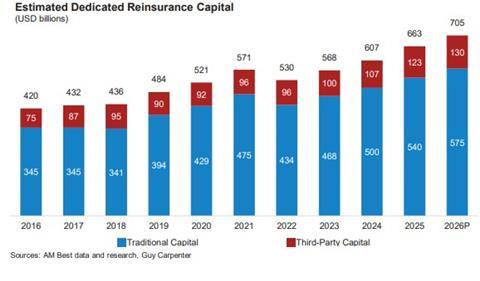
Dedicated reinsurance capital is projected to reach a record $705bn in 2026, up from $663bn in 2025 and $607bn in 2024 (see first chart, taken from the report). Of this, $575bn is traditional capital and $130bn third-party capital.
AM Best said: “The global reinsurance market approaches 2027 from a position of strength. Reinsurers have benefited from several years of improved underwriting conditions, elevated investment yields, disciplined capital deployment, and generally favorable catastrophe experience relative to pricing assumptions.”
However, the agency added: “Despite these favorable fundamentals, the market finds itself at a critical inflection point.”
“The question facing reinsurers is no longer whether the corrective actions taken during the 2023 market reset were successful. By almost all measures, they were. Instead, the focus has shifted to whether the industry can maintain discipline as capital continues to accumulate and competitive pressures increase.”
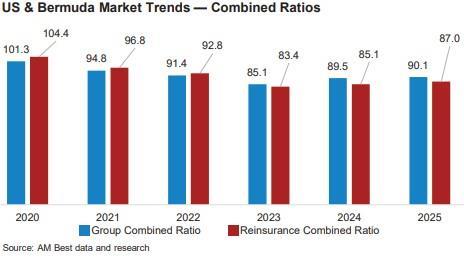
The strength of recent underwriting performance is illustrated in the report (see second chart).
Among US and Bermuda reinsurers, the reinsurance combined ratio improved from 104.4% in 2020 to 87% in 2025, while the European “Big Four” recorded a discounted reinsurance combined ratio of 79.2% last year.
Property cat faces first major test
Property catastrophe is emerging as the clearest test of whether reinsurers can preserve that discipline.
Risk-adjusted property cat rates fell by roughly 10% to 20% at the January 2026 renewals, while reductions at the April and mid-year renewals, particularly for US and Florida business, were widely estimated at 15% to 20%.
Higher attachment points and tighter terms established in 2023 have nevertheless largely remained intact.
“Most market participants continue to maintain that current pricing levels remain attractive and support adequate risk-adjusted returns on capital,” AM Best said.
“However, reinsurers now face a different challenge compared to two years ago. The industry faces an abundance of capital and relatively few areas where additional capacity can be deployed with acceptable risk return trade-offs.”
One factor supporting discipline is that capital accumulation has occurred predominantly among existing carriers rather than through a wave of new entrants.
Reinsurers have also diversified substantially beyond the traditional pure-play model into primary insurance, specialty underwriting and alternative capital businesses.
Exhibit 4 highlights that shift: reinsurance accounted for 68% of the business mix among the companies assessed in 2004, falling to 46.1% among the top 50 reinsurers in 2024.
Casualty uncertainty persists
AM Best also highlighted casualty as an increasingly important concern, particularly given uncertainty over whether rates are keeping pace with loss cost inflation driven by litigation funding, larger jury awards and adverse legal trends.
“Casualty exposures often develop over many years, meaning that decisions being made today may not be fully understood until well into the next decade,” the report said.
The agency also cautioned over the developing casualty ILS market, warning investors could underestimate the complexity and duration of liabilities, although it stressed such concerns do not apply universally to casualty-linked structures.
AM Best moved its outlook for the global non-life reinsurance segment to Stable from Positive at the start of 2026, reflecting its view that the industry is entering a more stable phase of the cycle.
It said: “If underwriting discipline and pricing integrity can be maintained despite record levels of capital, the industry may indeed be in the midst of a meaningful evolution of the reinsurance market. If not, history may once again demonstrate that while market structures change, the fundamental dynamics of supply, demand, and competition remain remarkably persistent.”









No comments yet