
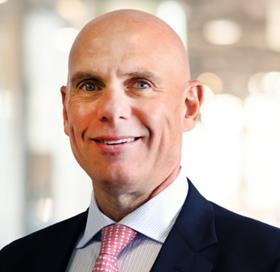
Chief executive Scott Egan says four years of turnaround work have put SiriusPoint on stronger footing with cedants and ratings agencies. That discipline now guides where capital goes next, with aviation flagged as the area still most in need of a rate fix
Specialty underwriter SiriusPoint will continue to pull back from business where pricing no longer rewards the risk, CEO Scott Egan says, while identifying aviation as the class he sees the clearest need for a rate correction if softening goes on.
Four years after joining, Egan says the insurer and reinsurer has strengthened its balance sheet and improved its standing with cedants and ratings agencies, while emphasising employee satisfaction levels.
“The company is in a stronger position today than in a long time, and it’s taken a lot of hard work by a lot of my colleagues to get us here,” Egan tells GR.
“The financial performance of the company has completely transformed. There’s not a part of it that we can’t do better, by the way, but in terms of holding a mirror up, it’s completely different to where we were.”

He points to ratings upgrades received from S&P Global Ratings, Fitch Ratings and AM Best as external validation of progress, while stressing there was “no complacency”.
Positive and determined
SiriusPoint is now predominantly focused on London, Europe, the US and Bermuda, and is positioned as a specialty underwriter after withdrawing from several markets as part of the company’s strategic repositioning.
Egan acknowledges reinsurance market conditions are less favourable than 12 months ago but also warned against assuming attractive business has disappeared.
“I do think there’s a danger that we talk ourselves into misery, and I think that’s not true,” he says. “There is money to be made. I think there are good risks out there that offer good return, and that includes areas like property catastrophe.”
Property cat represents 4% of SiriusPoint’s premium, after the group materially reduced its exposure.
The remaining portfolio is predominantly US focused, with some European business. Retention decisions are driven by whether price, terms and conditions meet the company’s return thresholds, he emphasises.
“We have a threshold; when terms go below that, we are prepared to take our capital and redeploy it in other parts of our business,” Egan says.
“Given how hard the industry worked three years ago to get rates to a level that really matched the risk we were taking, I’m very clear that here at SiriusPoint we will maintain that discipline.”
Underwriting at its heart
This approach reflects Egan’s emphasis on execution, which he has described as a defining part of SiriusPoint’s culture.
“Talk is cheap,” he says. “I’ve never seen a bad plan written in PowerPoint. Unfortunately, life isn’t written by PowerPoint; it’s written by delivery.”
Egan stressed that underwriting performance remains “the beating heart” of his strategy, alongside culture and the group’s approach to customers.
“This is a people business, and the day you forget that is the day you’re not successful,” he says. “People are what makes the magic happen.”
Egan says SiriusPoint aims to differentiate itself through responsiveness and agility, avoiding an automatic “no” when presented with unfamiliar or evolving risks, while also being prepared to give a quick rejection when a proposal does not fit.
The discipline applied in property cat extends elsewhere in the portfolio. Egan singles out aviation as the biggest pricing outlier.
“I don’t think it’s adequately priced That’s driven by frequency, unfortunately, and particularly in the major airline market. We’ve seen more accidents, and there’s the inflationary aspect to it as well.”
SiriusPoint took rate action in the high teens at the back end of 2025, he says, and believes a similar level is required again this year. “Aviation is our outlier in terms of a class of business. It’s the one that probably I’m most focused on in terms of needing rate.”
Casualty presents a more nuanced picture. Egan notes the market has carried strong rate for several years, generally above inflation, but increases are beginning to soften in some areas.
“That doesn’t mean it’s a bad marketplace,” he says. “It just means that the level of rate increases that we’ve seen now for a number of years are beginning to come down, and I think the question for the industry will be: does that match the inflationary drivers that we continue to see?”
MGAs and diversification
Diversification is central to SiriusPoint’s effort to produce lower volatility through the cycle, with accident and health (A&H) providing one counterweight to more volatile exposures elsewhere.
“We want to be lower volatility, not no volatility,” Egan says, linking that objective to SiriusPoint’s 12% to 15% across-the-cycle return on equity target.
“If A&H grows, then we can take more risk in what I would call more mainstream P&C, because effectively you don’t change the volatility profile of the group. If A&H shrank, then the opposite would also be true.”
Managing general agents (MGAs) are another major part of the model, accounting for around 60% of SiriusPoint’s premium, he observes. Egan says the group declines more than 90% of the MGA opportunities it sees, using underwriting, cultural, philosophical and data considerations to determine which relationships fit better than others.
“We are very selective about who we work with,” he says. “We love MGAs with deep expertise, deep underwriting expertise in markets and in areas and in niches.”
Its MGA partners have “skin in the game”, he adds, aligning their underwriting outcome withSiriusPoint’s own capacity.
The company is also building a data network with its MGA partners to allow information to be shared on a much more real-time basis, with roughly 60% of MGA premium expected to be connected by the end of the third quarter.
In London, SiriusPoint has reorganised its specialty operation and is adding fine art and specie and crisis solutions capabilities.
Egan says demand for crisisrelated cover is being driven by the geopolitical environment, while specialist underwriting talent is central to the expansion.
“In today’s world and today’s geopolitical environment, demand for crisis-related coverage has never been stronger,” he says.
The group’s stronger capital position is also widening its options. Egan points to small acquisitions in late 2025 and early 2026, share buybacks and continued organic growth, with insurance and services growing 11% in the first half of 2026.
“The most important part is capital strength gives you flexibility,” he says, adding: “The truth is, we’re doing all three. The great news is we’ve got the flexibility to do them all, we’ve got the agility to do them all, and we’re focused on them all.”
Click here to read the full digital issue of GR’s RVS special edition 2026









No comments yet