
With commercial liability losses reaching $174bn in the US last year, Swiss Re’s CEO explains that legal system abuse is driving claims payouts that ‘are not connected with the original underwriting assumptions’ – leaving the reinsurer ‘very concerned’
Swiss Re has confirmed that it has “zero” appetite for underwriting new liability business, particularly in the US, because of escalating legal system abuse – with lawsuits targeting “the deepest pocket” of corporates, “which are the insurance policies”.
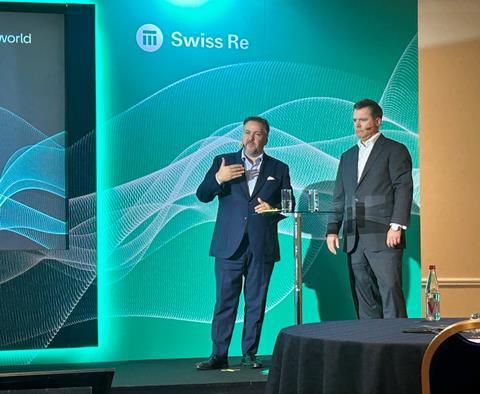
This change in underwriting appetite was explained by Urs Baertschi, property and casualty (P&C) reinsurance chief executive at Swiss Re, and Gianfranco Lot, the reinsurer’s P&C chief underwriting officer, during a briefing event at Monte Carlo’s Rendez-Vous de September (RVS) conference on 7 September 2026.
Addressing attendees, Lot emphasised that increasing legal system abuse – defined as the misuse of courts, laws, or legal procedures to trigger high compensation payouts – continued to “preoccupy” and “concern” the reinsurer.
The reinsurer’s worry is centred around the financial ramifications, with lawsuit payouts “not connected with the original underwriting assumptions and causation”.
For example, Lot highlighted that there has been 190 legal verdicts awarding $10m or more in the US last year – an increase of 41% year-on-year.
Baertschi, meanwhile, added that 2025 commercial liability losses in the US amounted to $174bn.
In contrast, global natural catastrophe losses reached $120bn – he said these figures demonstrated “an order of magnitude” regarding the scale of this legal system challenge.
“These record verdicts, they just keep coming up more frequently and they keep getting higher,” Baertschi continued.
“Ultimately, this is a cost to society and there are studies that would indicate that on average for the US household, the cost of [legal system abuse] is over $4,000 per US household per year.
“You see this when you go to the grocery store or home improvement store. That’s where you see this cost come through and it’s a big driver of why those prices are going up as well.”
Lot added: “It’s quite frustrating to see this continue [to] evolve and, therefore, our underwriting appetite for new liability business is almost zero.
“We keep what we [already] underwrite, but we don’t want to enlarge our footprint in US liability classes. We don’t see [legal system abuse] stop or reverse. The trend is there to stay.”
A prominent driver of legal system abuse, the Swiss Re speakers said, is an “influx of third party litigation funding” – where an outside party pays for a lawsuit’s legal fees and costs, taking a slice of the settlement if the lawsuit succeeds.
Lot noted that litigation funders are “securitising their funds and, therefore, accessing the retail markets and attracting more investment into their funds, which is quite remarkable”.
An expanding threat
Worryingly, Swiss Re observed that legal system abuse is expanding beyond its current realm of the “large commercial” sector in the US.
Baertschi told briefing attendees that smaller commercial players were now getting involved in this activity, with “different classes” of business also coming to the fore.
He said: “It’s going smaller. It’s going across different classes. You have the traditional ones like commercial motor or trucking that are there, but it’s also umbrella policies at a personal level.”
Lot flagged that there have been “certain developments in the UK” too, with “litigation funds being established there and more aggressive claims behaviour being displayed”.
‘A key challenge’
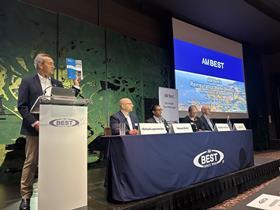
AM Best confirmed Swiss Re’s stance during its own RVS briefing event on 6 September 2026.
Michael Lagomarsino, senior director of global reinsurance at AM Best, commented: “Casualty reinsurance remains a key challenge.
“Social inflation, or what is often referred to in the US as legal system abuse, third party litigation funding and nuclear verdicts, continue to drive loss cost severity in US casualty lines. More specifically, we’re talking commercial auto, general liability, excess liability, and umbrella.
“And despite significant rate increases, underwriting actions and claims functions being tightened by primary insurers, there remains a significant amount of uncertainty on both price and reserve adequacy.
“This was evidenced by continued adverse prior year development on more recent accident years in 2022 through 2024 in calendar year 2025.
“At the same time, we do not expect meaningful tort reform in the US or changes to litigation funding practices to provide a material benefit over the near term.
“Reinsurers have responded by reducing capacity, lowering ceding conditions and seeking significant rate increases on excess of loss covers where it’s warranted. And we’ve seen a number of reinsurers culling their casualty reinsurance books further in the first half of 2026.”
Click here to read the full digital issue of GR’s RVS special edition 2026









No comments yet