
Conflict in the Middle East has exposed gaps in coverage, prompting calls for better risk management, more specialised capital and closer alignment between insurers, reinsurers and governments, an opening panel told attendees of DWIC Connect in Istanbul
The Middle East insurance market must rethink how it prepares for major geopolitical shocks after recent conflict exposed significant protection gaps across the region, industry leaders have warned.
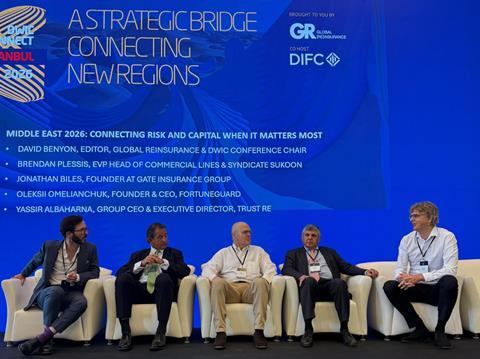
Speaking on a panel titled “Connecting risk and capital when it matters most”, Brendan Plessis, executive vice president, head of commercial lines and syndicate at Sukoon, said the industry needed to focus on resilience before an event rather than only responding afterwards.
“No other industry within the financial services sector provides the optimum usage of pre-event resilience capital to ensure that post-event scenarios play out to the benefit of those affected,” he said.
“As insurance practitioners, we tend to do the things that governments can’t,” he continued.
“These are things that we’re doing to ensure societal stability, which needs to be baked in from a capital perspective, as well as a best practice perspective, before events,” Plessis added.
Jonathan Biles, founder of Halo and Gate Insurance Group, underlined the industry’s fundamental role.
“At the end of the day, what we’re trying to deliver is a client who wants to get a risk off his balance sheet and transfer it to somebody else,” he said.
“Ultimately, it’s about clients and what they are trying to achieve and what we’re trying to help them achieve.”
Protection gaps exposed
Biles warned that demand for political violence and war insurance often emerges only after an incident has occurred.
“Nobody wants to talk to you about war risk until the day after your facility has gone up in flames,” he said.
“When a company starts up, day one, the risk is at board level. It’s the CEO dealing with it, and over time nothing happens, and you end up with a deputy accounts receivable clerk dealing with it.”
Yassir Albaharna, group CEO and executive director of Trust Re, estimated that recent insured losses could reach between $3.5bn and $4.5bn, potentially making the event the industry’s largest political violence and war loss, as well as the biggest single event insured loss event to have struck the Gulf region.
“This will probably be the largest insurance loss in this war and political violence arena that the industry has ever realised,” he said.
“This loss cuts through various lines of business. It’s on the energy side, it’s on the marine side, it’s on the business interruption side. It’s a lot of classes of business which are aggregating to this view of loss.”
Albaharna said insurers expected reinsurers to honour valid claims, but stressed that not every underlying exposure had been fully reinsured.
“There is no principle of back-to-back insurance,” he said.
“What is insured does not always get 100% reinsured. We expect reinsurers to honour their obligations, but that is not a carte blanche to pay all the claims. You have to see the policies.”
Oleksii Omelianchuk, founder and CEO of FortuneGuard, suggested that only a small proportion of assets seeking war protection had secured cover during the opening stages of the conflict.
“In the first two weeks of the war, a significant number of assets wanted coverage in the Middle East from war risks, but unfortunately only a small percentage of those were insured in the first weeks of the conflict,” he said.
“The key here is to make the region insurable because no insurance, no investment. The countries here are making massive investments in new infrastructure, which needs to be covered from drones and missiles,” he added.
Regional resilience
The panellists also considered whether governments and the industry should develop regional pools for political violence and other systemic risks.
Albaharna said existing arrangements could be expanded, including through greater public-private cooperation.
“A pool does exist. The Arab War Risk Insurance Syndicate is a pool formed by almost all insurance companies in the Middle East,” he said.
“Can it be more effective? Of course, it can be more effective by writing more, retaining more and lessening its reliance on reinsurance.”
Plessis said the industry could no longer rely primarily on historic loss experience when assessing emerging threats.
“We’re pretty good at looking at this with 20:20 vision; we’re not very good at going forward,” he said.
“We don’t live in that world anymore. We live in a very different world. We need to be deterministic in our approach to risk analysis.”
Looking three to five years ahead, Omelianchuk said success should be measured by whether clients could obtain meaningful cover at scale.
“Investments need insurance, and insurance needs capital, and specialised capital in this particular instance,” he said.
“That is the success story: when the client can get coverage any time they need it.”
Albaharna said the conflict should prompt companies to reassess their models, retentions and protection gaps.
“The tools are there, be it parametric, conventional, alternative or ILWs,” he said.
“There is sophistication enough to try to match the particular risk to the particular solution, and this is what I hope will be achieved in five years,” he added.









No comments yet