
Howden Re managing director Hugo Chelton says the $2.8bn Baltimore bridge loss will concentrate in reinsurance and test pricing discipline, even as abundant capital keeps conditions competitive
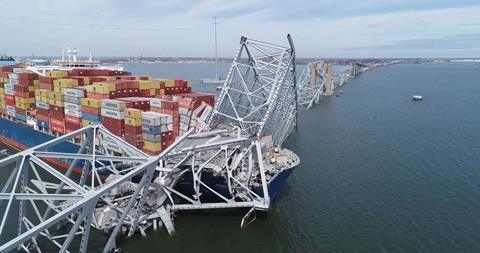
The insured loss from the collapse of the Francis Scott Key Bridge in Baltimore has risen to more than $2.8bn, cementing its position as the largest marine insurance loss on record, according to a briefing note from reinsurance broker Howden Re.
Early market reserves of around $1.5bn had shaped expectations through 2024 and even into the 1 January 2026 renewals.
The latest disclosures reflect a much broader set of liabilities than initially assumed, including bridge reconstruction, pollution, wreck removal and lost toll revenues.
At this level, the event surpasses the circa $1.6bn loss from the Costa Concordia grounding in 2012, long regarded as the sector’s benchmark.
The scale and pace of deterioration caught much of the market off guard, according to Hugo Chelton, managing director at Howden Re.
“The announcement came late on a Friday,” Chelton said.
“By Monday morning it had gained real momentum. A $1.3bn deterioration would be a major loss event in its own right, let alone when layered on top of what was already one of the largest marine losses the market,” he added.
The principal driver is the cost of replacing the bridge, with the settlement framework between the State of Maryland and its insurers accounting for roughly $2.5bn of the total.
Additional liabilities from pollution, wreck removal and business interruption have pushed the overall figure higher.
Central to the claims response is the International Group of P&I Clubs, which represents 13 mutual insurers covering marine liability risks.
Large claims are shared through the Group’s pooling mechanism and supported by a substantial excess of loss reinsurance programme, meaning an event of this size quickly extends into global reinsurance and retrocession markets.
Where does the loss land?
The majority of the $2.8bn insured loss is expected to be absorbed by reinsurers and retrocessionaires, according to reinsurance broker Howden Re.
While some market participants initially expected the full $3bn limit of the International Group’s reinsurance tower to be tested, the final settlement outcome has shaped how losses attach across layers.
“As the loss grows, it becomes increasingly concentrated,” Chelton said.
“The deepest exposure lies with the large reinsurers and the retro market. For some participants, relative to their own capital base, this will represent a very significant single loss,” he continued.
That concentration dynamic has been anticipated since 2024, when the loss event was already viewed as a potential record P&I and marine reinsurance loss despite legal uncertainty.
Market impact
The loss lands against a backdrop of much larger aggregate exposures across global portfolios, the reinsurance broker emphasised.
Marine, energy and terrorism risks are written alongside peak natural catastrophe exposures, particularly US windstorm.
“The same carriers writing marine liability are also exposed to hurricanes,” Chelton said.
“In that context, a truly severe event is a $100bn nat cat. A $2.8bn marine loss is material for the class, but it has to be viewed within the wider portfolio decisions these carriers are making.”
Even so, the cumulative impact of recent losses is building.
Aviation leasing settlements, alongside claims linked to ongoing geopolitical tensions in the Middle East, are adding pressure across many of the same balance sheets.
“Taken together, the cumulative effect is meaningful,” Chelton said.
“Something has to give. Marine liability rates will rise. Whether that translates into a broader market correction is less clear,” he added.
What comes next
Capital dynamics remain the key counterweight, according to Howden Re’s analysis.
Across marine, energy and terrorism classes, available capacity continues to exceed demand, with estimates suggesting limits remain several times higher than required for many large risks.
At the April 2026 renewals, pricing softened by as much as 15% to 20% in parts of the market, even as loss activity persisted.
New entrants have absorbed known exposures with limited adjustment, maintaining competitive conditions.
Loss-affected carriers have reassessed appetite, but fresh capital has continued to enter the market, keeping negotiating power with buyers.
“The market is navigating a complex set of signals,” Chelton said.
“Losses of this scale do shift thinking over time, and we are seeing the early conditions for that. The question for clients is how to position ahead of that turn, rather than react to it,” he added.









No comments yet