
Alistair Lester, CEO, private equity and M&A EMEA at Gallagher, said insurance is increasingly being used to transfer acquisition risks, facilitate deals, support financing, and help sellers secure cleaner exits
Insurance’s role in mergers and acquisitions (M&A) is “much misunderstood, much overlooked, and frankly, much undervalued”, according to Alistair Lester, CEO, private equity and M&A EMEA at Gallagher.
Speaking at The Global Risk Summit, hosted by the City of London Corporation at Guildhall, Lester said insurance has become increasingly important to dealmakers as private equity has grown its share of global M&A.
“There are around about 45,000 M&A transactions that happen every year,” he said.
“About 2,500 happen within London, and therefore largely advised upon by advisors and the professional services and financial services community here in the City of London.”
Lester said private equity now accounts for “something like a third, 30 to 40% of all M&A transactions”, making it a minority of deal volume but disproportionately important to the way insurance has developed around transactions.
“M&A deals are inherently about the allocation and the pricing of risk,” he said.
Traditionally, that risk was handled through price negotiation, deferred consideration, escrow arrangements or contractual protections.
Lester said that sellers, and especially private equity sellers, want “maximum day one unencumbered proceeds from an asset”.
Insurance can therefore play a role before a deal is contemplated, during due diligence, at completion, and after the transaction has closed.
This goes beyond the warranty and indemnity (W&I) insurance, otherwise known as representations and warranties, for which M&A insurers are best known, and which grew in premium volume following the global financial crisis.
“We’re increasingly seeing parties who are serial acquirers looking to understand thematic risk issues in a sector, in a geography,” he said.
He cited an aviation transaction where a potential acquirer wanted to understand claims trends, settlement values and wider themes in a segment of the general aviation market before it had identified a target.
Cyber risk is another area where dealmakers are using insurance insight earlier in the investment funnel.
“We are starting to see deal doers look and understand cyber risk on an outside-in basis before they even engage with third party targets,” Lester said.
Climate risk has also emerged as a critical issue for a subset of M&A participants.
“The insurance industry is the industry that’s been modelling climate risk for its own purposes for decades, has more climate data, has more climate models than any other industry in the world,” he said.
“We just needed to pivot that capability and deploy it into a different audience.”
Lester said W&I insurance remains the best known transaction product, but stressed that W&I is only part of the picture.
“It’s a key anchor product for the insurance industry’s role in M&A, but it is only one thing that we do,” he said.
“Yes, it’s about risk transfer, but it’s equally about deal facilitation.”
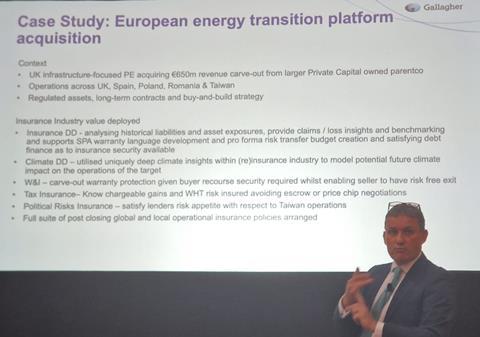
Tax liability insurance is also entering the mainstream, according to Lester.
He described one deal where a seller faced a $27m contingent tax liability.
A higher bidder offered $260m, but wanted a seven-year escrow for $27m, while rival bidders offered $240m without such conditions.
“The insurance industry was able to put in place a $27m tax insurance policy at a one-off premium, which was a fraction of the $27m, let’s call it less than 5%,” Lester said.
“As a result, therefore, the seller was able to realise nearly $259m of day one proceeds, because the insurance cost roughly one million dollars.”
Political risk insurance was cited as another example of potential growth.
Lester described a renewable energy infrastructure transaction with Taiwan exposure, where banks raised concerns through their risk committee.
“By buying political risk insurance, the borrower was able to improve the terms and tenor of the debt they were borrowing,” he said.
Cyber insurance is also becoming more closely tied to financing, he suggested.
“We’re starting to see banks put condition precedents on their financing agreements that target companies who are taking on the debt have cyber insurance in place,” Lester said.
Asked about claims, he said the market’s credibility depends on valid claims being paid.
“The moment that parties believe that claims are not being paid, which everyone associated with that transaction situation believes should be paid, they will not use it on the next deal,” Lester added.









No comments yet