
The industry should work more closely with governments, investors and corporate clients if climate-exposed nat cat perils are to remain insurable, speakers warned at the City of London Corporation’s Global Risk Summit
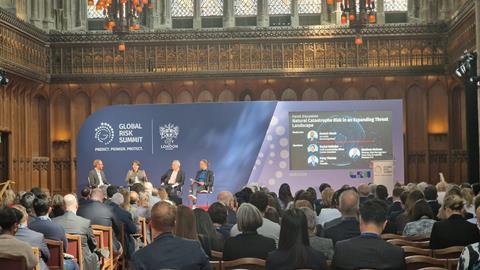
The insurance market will need to move beyond its short-term focus on pricing to play a broader role in resilience, protection gap reduction and investment planning, according to panellists at The Global Risk Summit.
Speaking during a session titled “Natural Catastrophe Risk in an Expanding Threat Landscape”, held at Guildhall in May 2026, Rachel Delhaise, group head of sustainability at Convex Insurance, said the protection gap should be seen in historical context.
“A protection gap of 40% [insured] to 60% [uninsured] needs context, because it was more like 15% to 85% in the 1980s,” Delhaise said.
But she warned that climate change is making uncertainty in nat cat modelling “much, much greater”, particularly for perils such as flood.
“It’s really important for us to understand what is the hazard, what is the exposure vulnerability,” she said.
“To what extent are increasing costs climate change driven? To what extent are they inflation, or supply chain costs?”
Perry Thomas, CEO of Flood Re, said the UK scheme was created to address market failure, but added that such interventions can create new challenges.
“Market failure for us was…the inability for people to afford the cover that would be needed,” Thomas said.
UK Government-backed Flood Re distributes a subsidy to those people. “That’s the social purpose,” he said.
Thomas said the UK government had invested heavily in flood defences, but added: “There’s only so much concrete you can pour.”
He said the changing nature of flood exposure, particularly surface water and groundwater events, means household-level resilience is becoming more important.
“Individual homes can take a lot of measures for resilience, but they need to be incentivised,” he said.
“Our existence removes the pricing signals in the market that provide that incentivisation. Sometimes we’ve corrected one issue, but we’ve created another.”
Matthew McEwan, director, risk management at Coca-Cola Europacific Partners, said nat cat and climate resilience are “front and centre” for large corporates.
He indicated that risk managers face a more complex environment as insurers rely on different models and produce inconsistent views of exposure.
“We use modelling, and undoubtedly the sophistication of the modelling industry has gone leap years in a very short way,” McEwan said.
“From a risk manager’s or [insurance] buyer’s perspective, it creates complexity in our property programme.”
McEwan suggested resilience is not only about property damage, but also business interruption, workforce safety and consumer impacts.
He pointed to heat stress in Spain as one example, where factories are considering cool rooms to help protect workers and reduce operational risk.
Delhaise said insurers should be brought into resilience and investment conversations much earlier.
“Insurers are brought late to the table,” she said.
“If you’re saying, ’we want to mitigate that risk over the next 10 years’, what does that feel like?
“That is a conversation that needs to be had with a broader audience than just risk management.”
Thomas suggested insurer behaviour after a flood is also crucial for take-up of build-back-better measures.
“If the insurance company is there on the day of the flood, or the next day, take-up is 90%,” Thomas said.
“But I see too many insurance companies who don’t turn up for three or four weeks.”
McEwan said the insurance industry must become more relevant to the key enterprise risks facing major companies.
“I think the insurance industry could be bolder,” he said.
“It is going to need to break away from short-termism and have more public-private collaborations. That’s not going to work for everybody, but I think it’s the ultimate solution.”









No comments yet