
Forecasters expect below-average storm activity in 2026, but Howden Re warned that a single landfalling hurricane can still drive significant insured losses
Reinsurance broker Howden Re expects the 2026 Atlantic hurricane season to be slightly below average, after several years of elevated activity.
The reinsurance intermediary’s “2026 Atlantic hurricane pre-season outlook” said early forecasts from major meteorological agencies point to lower storm counts and reduced accumulated cyclone energy, driven mainly by the expected development of El Niño conditions during the peak of the season.
“The 2026 Atlantic hurricane season outlook calls for slightly below-average activity,” the broker’s report said.
“Pre-season hurricane forecasts focus on activity-based metrics, like storm counts and accumulated cyclone energy (ACE).
“Two leading forecast organizations, Colorado State University and ECMWF, are forecasting most metrics to be 10-20% below average.”
The average forecast across organisations points to 13.4 named storms, 5.8 hurricanes and 2.3 major hurricanes.
That compares with the 1991-2020 NOAA average of 14 named storms, seven hurricanes and three major hurricanes.
Howden Re warned that the view is not unanimous, with the University of Arizona’s AI-assisted forecasting methodology suggesting an average to slightly above-average season.
“In addition, the forecast ranges released by most organizations span a range that includes near-normal activity. Despite this uncertainty, the consensus view across all forecasting groups is for a slightly below-average Atlantic hurricane season in 2026,” the broker cautioned.
The North Atlantic storm outlook is being driven by forecasts for a transition into El Niño by the hurricane season.
El Niño conditions typically increase upper-level wind shear across the Atlantic, reducing the ability of storms to form and intensify.
Atlantic Ocean temperatures have also moderated after the extreme warmth of 2023 and 2024.
However, Howden Re warned that the temperature outlook in the Atlantic is far from consistent.
“One notable exception to this is the western Atlantic and waters off the US east coast, where temperatures are forecast to remain above average,” the report said.
“This region is also typically less affected by El Niño-related wind shear.
“As a result, while the general outlook calls for below-average activity overall, storms tracking along the eastern seaboard may find conditions favourable for intensification.”
Anna Pergerson, managing director and head of catastrophe R&D at Howden Re, suggested seasonal forecasts are only one part of the risk picture.
“Seasonal forecasts provide useful context around the broader risk environment, but they don’t determine where storms will track or where losses will occur.
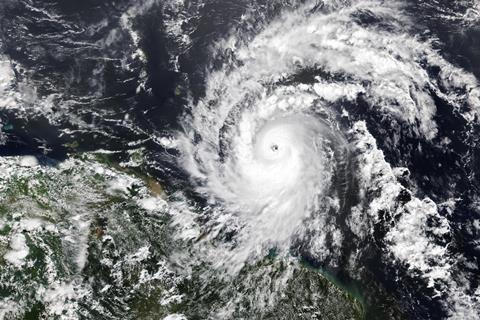
“Even in a below-average season, a single landfalling hurricane can drive significant insured losses,” she said.
For the reinsurance sector, storm counts may be a weaker guide to insured loss potential than regional intensity metrics.
Howden Re’s analysis found that ACE 60W, a subset of accumulated cyclone energy measuring storm activity west of 60° longitude, has historically shown a stronger relationship with US insured losses.
“Given the inherent uncertainty in seasonal hurricane forecasts, and the multitude of academic, government, and private entities releasing forecasts, it can be difficult to determine which signals matter most,” the report said.
“Ideally society, and the re/insurance sector, would know months in advance where hurricanes would make landfall.
“Unfortunately, that’s well beyond current scientific capabilities. Instead, we must focus on indicators that strike a balance between predictability and utility.”
The report pointed out: “Our analysis found that ACE 60W, a regional subset of ACE measuring storm activity west of 60W longitude, has historically shown the strongest relationship with insured losses.
“While ACE 60W is not a perfect solution for seasonal hurricane forecasting, it compares favorably with other metrics, such as the number of landfalling storms.”
The broker also highlighted NOAA’s adoption of the Relative Oceanic Niño Index, or RONI, as a preferred ENSO measure.
“RONI may help better explain overall seasonal activity, it does not determine whether any individual hurricane becomes destructive,” the report said.
Artificial intelligence (AI) is also becoming more prominent in hurricane forecasting, although Howden Re said its role is likely to remain complementary.
“AI forecasting models are unlikely to replace physics-based models or human forecasters entirely. Instead, they are expected to complement existing approaches.”
The report concluded that a quieter season does not remove the loss risk for insurers and reinsurers, particularly given coastal exposure growth, higher rebuilding costs and the potential for rapid intensification close to landfall.
Here’ s a link to the Howden Re report.








No comments yet