
Political violence and terrorism insurers need to generate more premium globally as tighter reinsurance terms leave the direct market retaining more losses, according to IGI group chief underwriting officer Chris Jarvis, speaking with GR editor David Benyon for an episode of The Political Risk Podcast
The direct political violence (PV) market needs higher premium income globally to deliver sustainable returns as reinsurers retain greater control over how losses can be aggregated and recovered, according to IGI’s group chief underwriting officer Chris Jarvis.
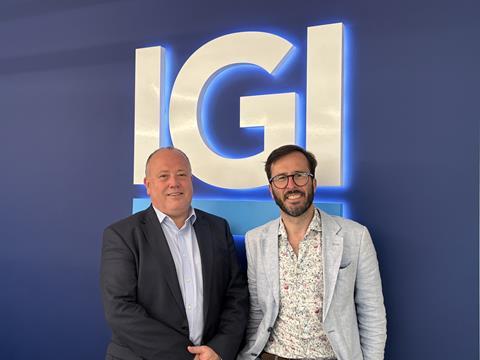
This year’s Middle East conflict had reinforced a divide between the economics of direct PV business and the same risks at treaty reinsurance level, Jarvis told GR editor David Benyon (pictured together) for an episode of The Political Risk Podcast, available here.
The US war with Iran has already eaten up roughly two years of PV premium in terms of PV claims events that have emerged, with the conflict not yet over, leading to a turning point at the market tries to increase pricing from previously low rates.
“The ability for PV to deliver sustainable returns is under the microscope like never before,” he said.
“The PV market has become unduly dependent on reinsurance to prop up what wasn’t really a sustainable position.”
Jarvis said reinsurers had tightened event definitions and aggregation provisions following losses from the 2021 South African riots and Russia-Ukraine conflict since 2022, after becoming uncomfortable with the volume of losses being pushed vertically through programmes.
“Reinsurers focused significantly on their event wordings, the product itself, the definition as to how insurers could aggregate losses, and how they could recover losses against their reinsurance programmes,” he said.
“They were also far stricter on aggregations and limitations, so they pushed insurers to give them far more data on their war exposures [and] their SRCC exposures.”
IGI subsequently saw greater opportunity at treaty level, where Jarvis said business had been written on a “far more controlled, disciplined, and better price basis”.
That overall assessment has not changed, he suggested, despite the latest Middle East losses.
“Generally, you’ll see war losses in the Middle East will be felt more harshly by the direct market. They’re not going to be pushing them all through to the reinsurers,” Jarvis said.
“We feel that that treaty product has still got some margin, and we think there’s still an opportunity to grow in the PV reinsurance sector.”
At direct level, IGI moved quickly to reduce its PV line sizes after conflict escalated in the Middle East this year, as have many PV underwriters.
Jarvis said the market had previously been characterised by increasingly large lines at less attractive prices, which had caused IGI’s regional PV book to shrink.
“The war saw a complete reset of that,” he said.
“What we’ve been able to do is operate on a much smaller gross line size, and start charging premiums we think are commensurate with the risk we’re taking on.”
IGI’s Middle Eastern heritage, Jordanian founded in 2001, provides an underwriting advantage, Jarvis said, despite the group now operating a geographically diversified portfolio.
Twenty five years later, IGI is a global specialty insurer and reinsurer, with its operational headquarters in Amman, Jordan, but.a worldwide portfolio, domiciled in Bermuda, listed in New York, and its underwriting centre in London.
Beyond PV, Jarvis revealed IGI is considering further expansion into credit and political risk, potentially through in-house expertise or a specialist MGA partnership, while also targeting cyber treaty reinsurance for 2027.
However, Jarvis said the more immediate challenge was ensuring direct PV pricing adequately reflected retained exposures and reinsurance costs.
“My own view is that this needs to be done globally. This isn’t just the Middle East issue,” he said. “Fundamentally, direct premium in PV has to increase globally in order for the market to become sustainable.”








No comments yet