
Howden Re commented saying it expects losses to remain well below the 2016 Kumamoto earthquake, although the extent of business interruption will depend on restart timelines at semiconductor facilities
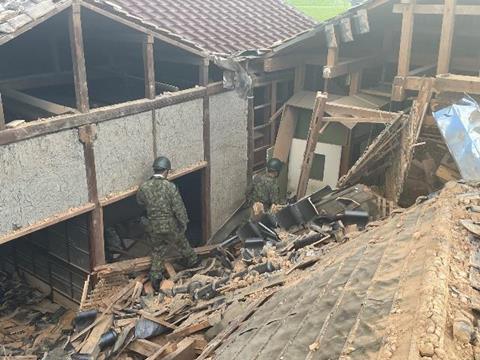
Verisk has estimated insured losses from the earthquake that struck Japan’s Kyushu Island on 28 July at between JPY220bn ($1.4bn) and JPY340bn ($2.1bn).
The catastrophe modeller’s estimate includes insured property losses caused by ground shaking and liquefaction and is calculated before recoveries through Japan’s earthquake insurance programme.
The earthquake struck south of Kumamoto City at a shallow depth of around 10km.
The US Geological Survey recorded a magnitude of 6.8, while the Japan Meteorological Agency reported a magnitude of 7.1.
Shaking reached Shindo 7, the highest level on Japan’s seismic intensity scale, in parts of Kyushu.
Early reports indicated dozens of fatalities, hundreds of injuries and localised structural damage, while authorities warned that the region continued to face a risk from aftershocks.
The event affected an area that experienced a destructive earthquake sequence in 2016, culminating in a magnitude 7.0 mainshock that caused widespread damage and loss of life.
Myrto Papaspiliou, head of international catastrophe model research at Howden Re, said the latest earthquake had similarities with the 2016 sequence, although its shaking footprint was slightly different.
“This event follows a similar magnitude and depth to the 2016 Kumamoto sequence, which culminated in a Mw 7.0 mainshock two days after an initial foreshock, and produced comparably severe local shaking, though across a slightly different footprint,” she said.
“Researchers Ross Stein and Shinji Toda had already flagged elevated stress on fault segments south of that rupture, so this event may have been promoted by it.”
Papaspiliou said the causative fault appeared likely to form part of the southern Hinagu or Yatsushiro system.
“While Japan is one of the world’s most seismically active countries, this part of Kyushu is not associated with its largest subduction-zone earthquake sources,” she said.
“The causative fault looks likely to be the southern Hinagu/Yatsushiro system, which geological evidence suggests may not have seen a major surface-rupturing earthquake for centuries, potentially several millennia.”
Verisk said the strongest shaking was recorded in Uki City and Hikawa Town in Kumamoto Prefecture.
Authorities reported damage to hundreds of homes and commercial buildings, as well as cultural landmarks, roads, bridges and rail infrastructure.
Around 48,000 households experienced power outages in the immediate aftermath.
The earthquake also affected Kumamoto’s semiconductor and advanced manufacturing sector, with facilities linked to TSMC and JASM, Sony and Tokyo Electron among those pausing operations for inspections.
Kentaro Tada, CEO of Howden Re Japan, said initial reports suggested damage to semiconductor infrastructure had been limited.
“Our focus right now is on those affected across Kyushu,” he said.
“Reported damage to Kumamoto’s semiconductor infrastructure appears limited so far, though restart timelines will determine the scale of business interruption losses.”
Verisk said its estimate was dominated by losses from ground shaking, with other modelled earthquake perils making a comparatively small contribution.
The range reflects uncertainty around the distribution of fault slip, ground-motion intensity, damage levels and earthquake insurance take-up rates.
The estimate includes insured physical damage to residential, commercial, industrial and mutual property risks, covering both buildings and contents.
It excludes uninsured property, infrastructure, automobiles, business interruption, workers’ compensation, marine and aviation losses, loss adjustment expenses, demand surge, landslides and fire following the earthquake.
Tada said it remained too early to produce a formal industry loss estimate but expected the event to be significantly less costly than the 2016 Kumamoto earthquake.
“It’s too early for formal estimates, but we’d expect insured losses to remain well below the 2016 Kumamoto earthquake and closer to the 2024 Noto earthquake, unless the aftershock sequence reveals more extensive damage,” he added.









No comments yet