
Reinsurance broker warns changing heat, drought and exposure conditions are increasing accumulation risk across multiple lines, despite Europe accounting for just 5% of global wildfire losses over the past decade
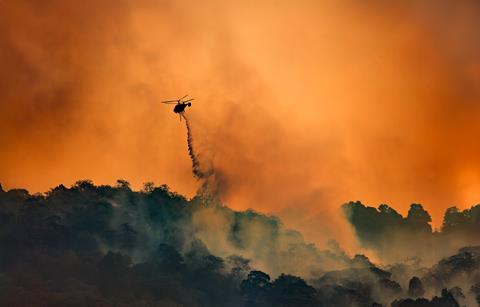
European wildfire risk is increasing even though the peril has historically generated relatively modest insured losses, according to new analysis from Howden Re.
Europe accounted for around 5% of the €173bn in global wildfire losses between 2016 and 2025, but the broker said changing climate conditions and development patterns mean historical experience may understate future risk.
Tim Edwards, head of Howden Re international catastrophe analytics, said recent European wildfire activity was likely to be the most significant in recent history by number of buildings damaged, although economic losses across private insurance, state schemes and other protections are expected to be around or below €0.5bn.
“The reality is that, while there has undeniably been a tragic impact, the latest European wildfire events are not yet on the same scale in terms of societal impact as wildfires in other parts of the world or other catastrophe perils in Europe,” he said.
Edwards pointed to Spain’s 2025 wildfires, where around 400,000 hectares burned but generated only about 900 claims and €23m of insured losses.
“Now is the time to build a deeper understanding of how wildfire risk will evolve, learning from these events and the experience of North America and Australia,” he said.
Howden Re said Europe’s building stock has so far reduced loss severity compared with other wildfire-prone regions.
“Europe generally has stricter planning restrictions around development in the wildland-urban interface, so fewer people and properties are built immediately adjacent to high-risk wildfire zones,” Edwards said.
“Crucially, European properties are typically constructed using masonry, concrete and tiled roofs, all of which are generally less susceptible to fire than the timber-frame construction more common in some other regions.”
However, he added that Europe is “warming faster than many other regions of the world”, with longer periods of extreme heat and drought increasing wildfire-conducive conditions.
Danielle Dron, vice president and general manager at Insurity Analytics, SpatialKey, suggested historical loss data alone was insufficient.
“The challenge with wildfire is that climate conditions are changing quickly, and clients need tools to help them understand where that risk could emerge and how exposure accumulates over time,” she said.
Tobias Anderson, head of Continental Europe at Howden Re, said higher reinsurance retentions mean emerging perils such as wildfire can increasingly hit cedents’ earnings.
“Perils that do not yet generate single-event losses, such as wildfire, are therefore disproportionately impacting cedents’ profit and loss accounts,” he said.
Howden Re said parametric reinsurance could play a growing role in managing wildfire volatility as the peril develops.
Anderson added: “Howden Re’s climate scientists and parametric reinsurance experts offer clients the proven capability to secure significant reinsurance capacity on a parametric basis, with advanced modelling techniques used to minimise basis risk and ensure cover is aligned with the classes and timescales that wildfires may affect.”









No comments yet