
Property-cat rates fall back to early 2020s levels as specialty lines absorb geopolitical shock, according to reinsurance broker Howden Re
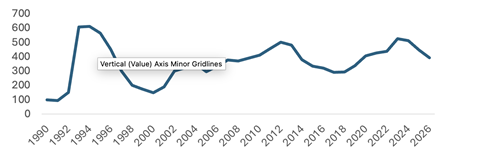
Reinsurance renewals at 1 April continued the softening trend seen at the start of the year, with risk-adjusted property catastrophe rates-on-line returning to levels last seen in the early 2020s, according to Howden Re.
The broker said cedants benefited from strong reinsurer appetite and benign loss experience, even as geopolitical tensions in the Middle East drove sharp dislocation across specialty lines including marine war, energy and political violence.
In Japan, catastrophe excess-of-loss programmes saw risk-adjusted price reductions of up to 20%, with a point estimate of around 16%, reflecting favourable market conditions and another relatively low catastrophe loss year.
Within proportional placements, commissions increased by 2–5 percentage points, particularly on earthquake quota share treaties.
Andy Souter, head of Asia Pacific at Howden Re, said pricing has effectively reset.
“Japan rates are now broadly back to early twenties levels,” he said.
“Strong reinsurer appetite, improving underlying performance, and a lack of major loss activity have all contributed to cedant-friendly outcomes at this renewal,” he added.
Despite the softer pricing environment, reinsurers maintained discipline, largely defending existing positions while selectively deploying additional capacity.
Programme structures remained broadly unchanged, with limited additional purchases or structural adjustments, suggesting a stable balance between supply and demand.
The escalation in the Middle East, including the effective closure of the Strait of Hormuz, had little direct impact on property-catastrophe renewals at 1 April.
Instead, disruption has been concentrated in specialty markets, where pricing for marine war, energy and political violence risks has risen to multiples of pre-conflict levels.
David Flandro, head of industry analysis and strategic advisory at Howden Re, said the broader implications of the crisis are still emerging.
“This renewal was completed in a largely benign property-catastrophe environment, insulated from the immediate disruption in the Gulf,” he said.
“That said, a sustained energy supply shock raises the risk of renewed inflationary pressure and higher interest rates, dynamics that have historically affected reinsurance capital and pricing across all lines, not just those directly exposed to the conflict,” he added.
Looking ahead, Howden Re expects more complex conditions for mid-year renewals, as reinsurers reassess exposures and pricing across specialty classes.
Upward pressure is anticipated in marine, energy and political violence lines, while the trajectory for property-catastrophe pricing will depend on loss activity and macroeconomic developments over the coming months.
Souter said the market remains well positioned but faces a more uncertain outlook.
“The reinsurance market remains well capitalised and engaged,” he said.
“Technical discipline, transparency and active monitoring are essential as we move into what is shaping up to be a more complex mid-year environment,” he added.







No comments yet