
War risk cover remains available, but cancellations, spiking pricing and reinsurance withdrawals have contributed, alongside risk perception of insureds, to sharply reduce tanker transits through one of the world’s most important energy chokepoints
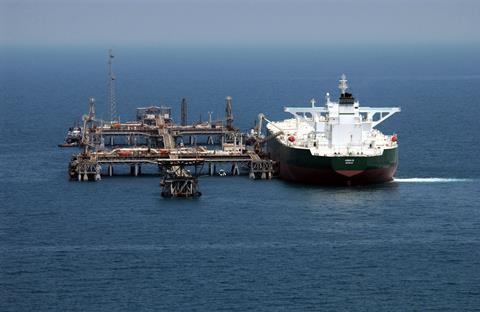
Marine re/insurance has attracted popular attention as a significant factor in determining whether shipping continues to move through the Strait of Hormuz as the conflict in the Middle East continues.
Shipping traffic through the narrow waterway fell sharply since the US and Israel opened hostilities with Iran on Saturday, leading to retaliatory Iranian strikes against its Israel and the Gulf monarchies.
As part of its retaliatory actions Iran has vowed to close the Strait of Hormuz, the strategic chokepoint for the trade artery in and out of the Arabian Gulf.
Several merchant vessels have already been damaged or sunk already in the Strait of Hormuz, and within 24 hours transit through the narrows had dropped by 80%.
“The cause wasn’t just physical strikes, but the withdrawal of reinsurance,” said Michelle Wiese Bockmann, senior maritime intelligence analyst at Windward.
“The role of marine insurers in halting traffic through the Strait of Hormuz during a time of war is going to be something that will be debated in years to come,” she said.
Amid initial uncertainty, vessels diverted or attempted to exit the Gulf eastbound while waiting for clarity on both security conditions and insurance availability.
The situation has left hundreds of vessels stranded across the region, bottled up within the Gulf or stranded at anchorages unable to enter.
War risk cover has not disappeared
Insurance sources have been keen to stress that war risk protection has not entirely disappeared, the current situation is temporary during a crisis, and the mechanisms of the market are taking some time to adjust to a fast-changing risk environment.
The Joint War Committee, representing London market re/insurers, met at the start of this week to agree a new listed area requiring war protection for coverage to be valid, including the whole Persian Gulf, eastwards to the Arabian Sea off the coast of Pakistan, westwards to the southern Red Sea and southwards off the Somali coast and the Horn of Africa.
War risk premiums for vessels within the listed area have risen sharply, reportedly surging surged from 0.2% to as high as 1% of vessel value.
“The granting of war cover for the Persian Gulf and Red Sea is and will remain available under specific agreement on a single voyage basis as long as navigation is authorised by governments and flag states,” said a statement from the International Union of Marine Insurance (IUMI).
The repricing reflects both the physical threat environment and the concentration of vessels in confined areas, which raises the possibility of large accumulation losses.
Shipping economics are also distorting behaviour.
Despite the obvious risks for crews, a surge in freight rates for tankers may lead some shipping firms to run the gauntlet, with or without war risk protection.
Reports suggest a small number of ships have continued to pass through the strait, sometimes described as “dark transits”, but without insurance most commercial shipping cannot operate.
Cancellation notices trigger market reset
Some of the disruption stems from the mechanics of marine war insurance.
War risk cover is typically provided through policy extensions or additional premiums applied temporarily while vessels transit designated high-risk areas.
As tensions have escalated, insurers began serving cancellation notices on those extensions, causing a cascade through the system of protection and indemnity (P&I) mutual clubs.
“That triggered P&I clubs to issue cancellation notices with 72 hours’ notice, effective March 2, with those add on policies expiring on March 5,” Bockmann said,
However, the cancellation process does not eliminate cover permanently. Instead, it allows insurers to reassess exposure and reinstate coverage at revised terms once pricing and risk appetite have been reconsidered.
IUMI took care to underline this point: “It is important to recognise that a notice of cancellation does not, necessarily, end the cover. War cover remains available for owners and operators wishing to take it,” the marine insurers’ group said.
“By way of explanation – in circumstances such as these, some insurers will serve a notice of cancellation in relation to the cover their assureds have in place. This is to enable the insurer to reassess the risk and then reinstate the cover at adjusted terms,” IUMI added.
For now, a combination of factors based on the same underlying risk realities mean the strait is more-or-less closed.
“The waterway is effectively closed by risk assessment,” Bockmann acknowledged.
“The safety of seafarers will be a priority for owners,” IUMI said.
Bockmann continued: “Until replacement war risk cover is secured and insurers regain confidence that vessels can safely transit the waterway, one of the world’s most critical energy chokepoints remains effectively closed.”
“IUMI added: The situation remains fluid with a number of vessels being trapped in the Persian Gulf and many operators re-routing their vessels to avoid the high-risk areas. We are likely to see disruptions to supply chains in the short term, as a result.”
Editor’s addendum – Trump’s bizarre statement
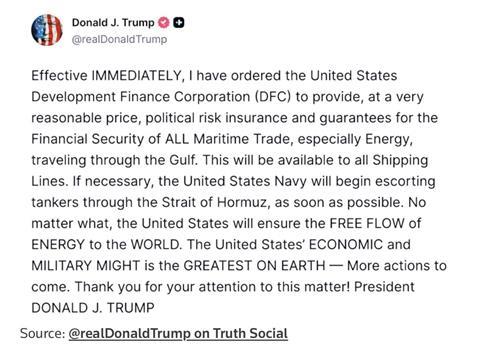
US President Donald Trump has made a rare foray into the world of commercial re/insurance with a statement on his Truth Social media page.
Without further explanation, he tasked the US Development Finance Corporation (DFC) with providing political risk insurance and financial guarantees for tankers transiting the Strait of Hormuz.
It might be assumed Trump meant marine war risk insurance, as political risk insurance tends to refer to protecting investments against confiscation or expropriation, rather than physical damage to ships.
As the international investment arm of the US government, the DFC has a track record of providing political risk coverage to US trade and investments operating in high-risk environments.
It has also previously turned to private re/insurance markets, for instance seeking political risk reinsurance protection related to so-called green or blue bonds, issued in a deal to restructure Ecuador’s sovereign debt in return for responsible stewardship of environmental risks to Galapagos.
The same statement from Trump also offered US naval escorting of tankers through the Strait. Aside from planning or peace-time exercises, the last time this was carried out operationally was in 1987-1988 under US Operation Earnest Will during the Tanker War phase of the Iran-Iraq war.
The US reflagged Kuwaiti oil tankers as American vessels in the largest naval convoy operation since WWII, providing them with a mix of government legal and US Navy protections against Iranian attacks.
Without further detail from the US administration, it is hard to provide further meaningful comment about how such arrangements might work in practice for the current crisis.









No comments yet