
Political risk protection for carbon projects and their financial backers is seen as increasingly necessary due to the location of many renewables and other net zero projects within unstable or risky countries, as the carbon trading business is projected to grow globally
MS Amlin has partnered with Kita to launch a new non-payment insurance product designed to unlock financing for carbon and natural capital projects by transferring counterparty credit risk to rated insurance balance sheets.
The product will be led by MS Amlin, with additional capacity provided by Chaucer Group and Tokio Marine Kiln, and marks a further expansion of Kita’s suite of carbon-focused insurance solutions.
Kita said the non-payment insurance (NPI) product is designed to protect lenders against the risk of non-payment under project finance, prepayment facilities, offtake receivables and other credit exposures linked to carbon and natural capital projects.
By shifting counterparty credit risk onto A-rated insurance balance sheets, the cover aims to reduce loss-given-default, support regulatory capital relief for banks and lower the overall cost of capital for project sponsors.
The policy can be applied to individual projects or to portfolios spanning multiple jurisdictions, supporting financing structures ranging from early-stage scale-up to large infrastructure investments.
Typical use cases include pre-financing against contracted offtakes, working capital facilities and improving lender terms within project finance structures.
The product is designed to support pay-on-delivery and prepayment structures, wrap counterparty exposures within SPVs and protect aggregated exposures across portfolios and warehousing arrangements.
Kita said this flexibility is intended to help banks and investors move past credit concerns that can otherwise stall credible projects, particularly in emerging markets.
Louise Scott, political risk underwriter at MS Amlin, said the partnership reflected the insurer’s focus on deploying balance sheet strength to support climate-related investment.
“We’re proud to be the lead capacity provider, which reflects our belief in the role insurers can play in unlocking capital for climate and nature-based initiatives, an area we’ve made significant inroads into, recently,” she said.
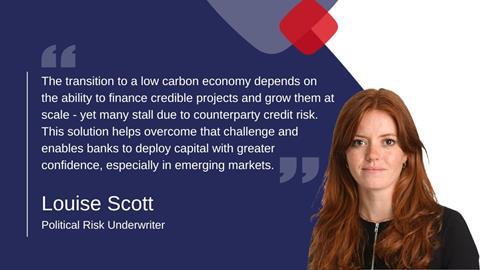
“The transition to a low carbon economy depends on the ability to finance credible projects and grow them at scale, yet many stall due to counterparty credit risk. This solution helps overcome that challenge and enables banks to deploy capital with greater confidence, especially in emerging markets.”
James Kench, managing director, insurance at Kita, said risk transfer was essential to scaling climate finance.
“Financing the transition needs more than good intentions – it needs bankable risk transfer,” he said.
“Non-Payment Insurance gives banks and investors the confidence to fund credible carbon and nature projects at scale. By moving counterparty risk onto a strong, regulated balance sheet, Kita’s NPI can offer lenders and buyers the protection they need to unlock capital and move projects from pipeline to real-world impact.”
Alek Pillay, head of underwriting at Kita, said non-payment insurance was already well established across banking markets.
“NPI has been supporting banking activity across a wide range of markets and sectors for many years, often as a pre-requisite for a deal to be finalised,” he said.
“With capacity led by MS Amlin, Kita is aiming to bring these benefits to the carbon and natural capital markets to help them scale.”
The launch follows a period of rapid expansion for Kita, including a significant increase in underwriting capacity, broader project eligibility and the extension of its non-delivery insurance to cover both supply-side and demand-side risk.









No comments yet