
General Sir Richard Shirreff of Strategia Worldwide told a Russell Group event that wargaming is a more proactive form of scenario analysis that can more effectively test assumptions, exposing blind spots and identifying opportunities as well as threats
Multinationals and their commercial insurers facing geopolitical volatility should use wargaming to challenge their assumptions and strengthen balance sheet resilience, rather than relying solely on conventional scenario analysis, according to General Sir Richard Shirreff (pictured, left of photograph).
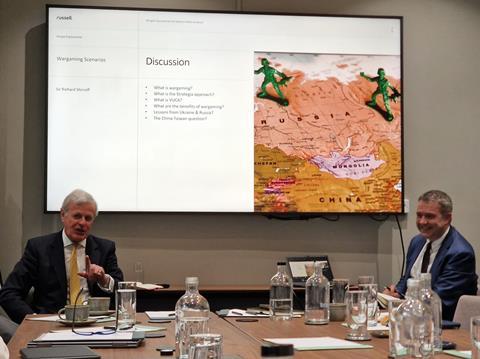
Speaking at Russell Group’s “Wargaming scenarios for balance sheet resilience” event, Shirreff, managing partner of Strategia Worldwide, said a wargaming approach forces organisations to test how a plan might fail before a real crisis hits.
“You may have the most sophisticated risk management system,” he said.
“You’ve got spreadsheets covered in green, amber and red, but you can’t tell what’s going to happen.”
A war game, he explained, typically involves a blue team, representing the organisation and its plan, a red team, representing the adversary or challenge, and a white team or umpire to test outcomes.
“The red team is there to say ‘if you do that, this is what we’re going to do to screw you up’,” Shirreff said.
“At the end of the day, the umpire will then say, for instance, ‘if red team do that, then, on the balance of probability, you’re not going to succeed’.”
The value, he argued, lies not in predicting the future, but in forcing decision-makers to rethink assumptions and identify mitigations.
“Nobody can foretell the future,” he said. “This wargaming approach allows you to think laterally.”
He cited World War II commander Dwight Eisenhower’s quote that: “Plans are worthless, but planning is everything.”
Red team composition
Shirreff emphasised that a good red team should not be made up only of senior insiders or risk managers, because this can reinforce existing biases.
“I would always urge that red team should consist of the most anarchic, free-thinking, lateral thinkers you’ve got in your organisation who are really prepared to challenge the plan,” he said.
He stressed that insiders, even free-thinking ones, are not enough.
“You also need people from outside who are going to be the grit that produces the pearl in the oyster, and can really challenge thinking.”
He gave the example of wargaming work with a large Australian mining company, in which a newly installed CEO wanted to test the business after a dam collapse in Brazil.
The company was also heavily exposed to China, so Shirreff said Strategia ran two war games, one on the demand side and one on the supply side.
“We put together the red team with a combination of corporate insiders and experts from outside,” he said.
“The challenge was this company was massively exposed in China, so we needed expertise on where China was going to test that thinking.”
The Russell Group event discussion also considered how companies should test their exposure to current geopolitical flashpoints, including the Middle East and a potential China-Taiwan confrontation.
Shirreff said the danger with conventional scenario analysis is that it can become too bounded, with organisations selecting a fixed list of scenarios and treating the exercise as complete.
“If you do it in an iterative, collegiate way with a red team with lateral thinking, it creates insights and thoughts which you hadn’t thought about,” he said.
“Too often the scenario thing is a little bit bounded. You need to have another way of unbounding it.”
Participants also discussed whether wargaming should sit alongside crisis management and business continuity planning.
Shirreff said crisis management provides more of a top-level view.
“Crisis management is tactical: how do I keep business going?” he said. “Wargaming is strategic.”
He added that the approach can help companies find opportunities as well as identify effective defensive measures.
“Opportunities are the flip sides of threats and risks,” Shirreff said. “Fortify the trenches is the crisis management. How do we advance and succeed is the war game.”









No comments yet