
New modelling suggests civil unrest insured losses could exceed £4bn under certain triggers, as carriers urged to rethink postcode-level accumulation approaches
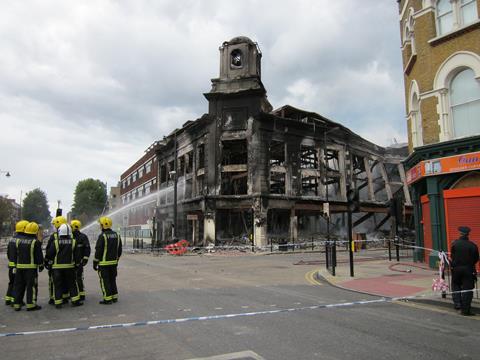
Civil unrest in the UK is no longer a background exposure for property and specialty underwriters, but a catalyst-driven accumulation risk that can scale rapidly along defined urban corridors.
That is the conclusion of a new report, “Civil Unrest in the UK”, from Synthetik Insurance Technologies, a Lloyd’s Lab graduate, which uses its srccQuantum platform to model four trigger-based scenarios for strikes, riots and civil commotion over the next 12 to 24 months.
The study argues that the UK’s “well-established protest culture and permissive framework for assembly now operate against a backdrop of heightened cadence, multi-city spillover, and faster escalation”.
It points to “a surge in protest volumes (thousands annually; 3,000+ events in just three months of 2025)”, which is stretching policing and retail security and increasing “the probability that planned marches tip into opportunistic disorder”.
Four activation pathways
Synthetik structures its analysis around four vignettes: asylum-hotel flashpoints, a policing incident catalyst, overseas conflict spilling into domestic mobilisation, and a sovereign-debt stress scenario.
Under the policing-incident scenario, losses are modelled rising from around £0.6bn at low severity to approximately £4.4bn at very high severity, described as “the steepest severity gradient” of the four pathways.
The overseas conflict vignette produces the highest overall range, with predicted losses of roughly £0.7bn to £4.7bn, reflecting “episodic mobilisation cycles… producing cumulative pressure rather than shock losses”.
By contrast, accommodation-linked unrest produces a lower but more geographically diffuse range of about £0.3bn to £1.7bn, highlighting what the report calls a regional commuter-belt accumulation layer.
A sovereign-debt stress scenario shows losses in the region of £1.0bn to £3.4bn across medium to high intensity bands, with business interruption playing a dominant role.
Why postcode views fall short
Central to the report’s thesis is that existing strikes, riots and civil commotion (SRCC) models remain overly dependent on historical and macro-level indicators.
“Whilst useful for regional risk aggregation, macro-level data falls short in delivering the granularity required for accurately identifying event-specific SRCC exposure and risk, particularly at the property and portfolio level,” the report states.
Instead, the firm argues that UK SRCC “is no longer a diffuse, background peril; it expresses as a route-based accumulation risk whose probability, severity, and duration vary by catalyst”.
That shift has direct implications for pricing and capital management.
“For carriers and syndicates, that means pricing, accumulation control, and capital sensitivity hinge on where crowds move, which nodes they touch, and how long disruption persists. A generic postcode view will miss the clustering that drives tail outcomes,” the report adds.
Three underwriting implications
The modelling highlights three key findings for carriers and brokers.
First, “losses scale non-linearly when unrest routes converge near dense retail, police, and transit nodes”, meaning corridor exposure becomes a predictor of tail risk.
Second, “moderate per-event losses in multi-week scenarios… can approximate or exceed shock-event impacts when compounded with BI”, underlining the need for event definition discipline and temporal aggregation awareness.
Third, distributed town-belt risk represents “a regional accumulation layer… that may be under-appreciated compared with London-centric tail scenarios”.
Tim Brewer, chief operating officer of Synthetik, said the UK market must adjust to a different loss dynamic.
“SRCC in the UK has evolved from a background peril into a route-based accumulation risk that is critical to monitor accurately,” Brewer said.
“The severity and spread of loss depend on how civil unrest manifests across spaces, creating concentrations of exposure that may not be visible in more generalised approaches. For underwriters and brokers, this represents a significant change in how risk is priced, monitored, and accumulated across portfolios,” he added.









No comments yet