
Uncertainties about provision of naval escorts and Iranian threats from mines, drones and missiles face the new marine re/insurance facility announced yesterday by the US International Development Finance Corporation
News that the US International Development Finance Corporation (DFC) and Chubb have partnered on a marine reinsurance scheme to get traffic moving in the Persian Gulf remains subject to some major uncertainties.
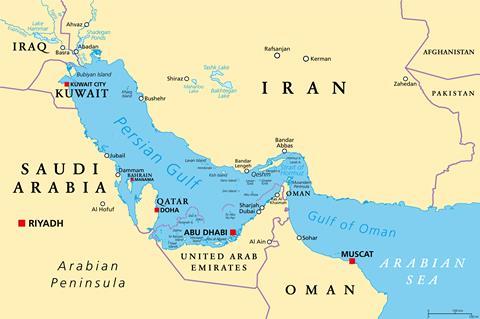
Big problems centre on the need for naval protection, the danger of Iranian mines at sea, as well as the drone and missile threats already causing casualties.
Three more civilian ships were attacked in the Gulf overnight, two off southern Iraq, another off the UAE coast, according to UK Maritime Trade Operations, the UK-run volunteer reporting centre for attacks on international shipping in the region.
Despite the attacks, US President Trump has encouraged shipping traffic to return to the Strait of Hormuz (SoH).
“These ships should go through the Strait of Hormuz and show some guts,” Trump told Fox News.
The SoH is the chokepoint through which trade must enter or exit the Gulf, just 21 miles across at its narrowest point, with the Iranian coast to its north.
The announcement of the DFC scheme, partnerred with Chubb, was created in response to accusations of a gap in the availability of war risk insurance protection for SoH transits.
Escort required
Without provision of US naval escort, the new insurance scheme, led by Chubb and backed by the US government, is understood to be unable to function.
“What is known is that the offer of cover is strictly linked to a naval escort,” one senior marine insurance source told GR.
General Caine, chairman of the US military’s joint chiefs of staff, has spoken about “potentially” escorting ships through the Strait of Hormuz, at a press conference held yesterday, speaking alongside US Secretary for War, Pete Hegseth.
“If tasked to escort, we’ll look at the range of options,” Caine said.
Sal Mercogliano, an associate professor of history at Campbell University in North Carolina and adjunct professor at the US Merchant Marine Academy, has asked why the US Navy did “not already have these options already planned out and war gamed?”
Commenting via social media platform X, Mercogliano added: “There is no current tasking to escort ships and resume the flow of traffic through the Strait. Figuring out problems as they come is great, but this should have been looked at before.”
Mine danger
Reports suggested Iran had begun mining the Strait of Hormuz, while the US military has already claimed that at least 16 Iranian minelaying vessels have been sunk.
Once Iran has laid naval mines in the strait – or is believed to have done so – removing those mines to a high degree of confidence would likely be a precursor to shipping returning, with or without naval escort.
“In the old days, a report of mines would close the strait, an actual mine doubly so, and two to three months to sweep through,” said a senior marine market source.
Drones could potentially speed up this task, but more traditional mine hunting assets are also absent from the area, and have not been replaced by dedicated mine hunting assets.
Both the US and UK previously maintained specialist mine hunting ships in the Gulf, but none of these are still present in the region today to play a role in clearing mines from the SoH.
The last of four British mine hunters previously in the region in recent years returned to the UK just days before the start of the conflict.
“The US Navy kept four mine countermeasure vessels in the Persian Gulf for the past 35 years. These ships and crews have trained for this very circumstance,” Mercogliano said.
“The minesweepers just arrived in Philadelphia yesterday to be decommissioned, but we have three Littoral Combat Ships that took their place,” he added.









No comments yet